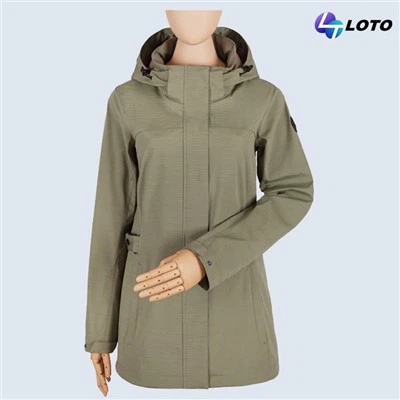
Sewing is the central process of Denim Ski Jacket processing. The sewing of garments can be divided into machine sewing and manual sewing according to styles and craftsmanship. In the sewing process, the assembly line is carried out.
Adhesive lining is widely used in garment processing. Its function is to simplify the sewing process, make the quality of the garment uniform, prevent deformation and wrinkling, and play a certain role in the shape of the garment. Its types are mostly non-woven fabrics, woven fabrics, and knitted fabrics. The use of adhesive interlining should be selected according to the fabric and parts of the clothing, and the time, temperature and pressure of the adhesive should be accurately grasped, so as to achieve better results. .
In the processing of woven garments, the stitches are arranged in series on the garment piece according to a certain rule to form a firm and beautiful stitch.
Stitches can be basically summarized into the following four types:
1. Chain stitch Chain stitch is formed by connecting one or two sutures in series. A single stitch is called a single chain stitch. The advantage is that the amount of wire used per unit length is small, and the disadvantage is that the side lock will come off when the chain line is broken. The stitch of double stitches is called double chain stitch, which is formed by a needle thread and hook thread interlocked with each other. Its elasticity and strength are better than lock stitches, and it is not easy to come off. Single-thread chain stitches are often used in the hem of the jacket, the seam of the trousers, the lapel of the suit jacket, etc. Double chain stitch is often used for hem and dart stitching, back seam and side seam of trousers, elastic band and other parts that are stretched and stressed.
2. The lock stitch, also known as the shuttle stitch, is cross-connected in the sewing material by two stitches. Straight lock stitch is the most common stitching stitch. Due to the small amount of thread and poor stretchability, it is often used for the stitching of two pieces of sewing material. Such as hemming, dart seam, bagging, etc.
3. Overlock stitches are stitches that are looped over the edge of the sewing material by a number of stitches. It is named according to the number of stitches that make up the stitches (single-thread overlock, double-thread overlock…six-seam overlock). Its feature is that the edge of the sewing material can be wrapped to prevent the edge of the fabric from falling apart. When the stitches are stretched, the upper thread and the bottom thread can be mutually transferred to a certain extent, so the elasticity of the stitches is better, so it is widely used in the hemming of woven fabrics. Three-thread overlock and four-thread overlock are the most commonly used hemming of woven garments. Five-thread overlock and six-thread overlock, also known as "composite stitches", are formed by combining a double-thread overlock with a three-thread or four-thread overlock stitch. Its biggest feature is that it is strong and can be stitched and overlocked at the same time, thereby improving the density of seams and the production efficiency of sewing.
4. Coverstitch stitches are made of two or more needle threads and a hook thread intertwined with each other, and sometimes one or two decorative threads are added on the front. Coverstitch stitches are characterized by strong strength, good stretchability, and smooth seams. In some occasions (such as stitching seams), they can also prevent the edge of the fabric from falling apart.
The form of basic stitching is shown in Figure 1-13. In addition to basic sewing, there are other processing methods such as pleating and appliqué according to the style and process requirements. The selection of needles, threads and stitch density in the sewing of woven garments should take into account the texture and process requirements of garment fabrics.
Sewing needles can be classified by "type and size". According to the shape, sewing needles can be divided into S, J, B, U, and Y types, and corresponding to different fabrics, appropriate needle types are used respectively.
The thickness of the needles used in our country is distinguished by the number, and the thickness becomes thicker with the increase of the number. The size of the needles used in garment processing generally ranges from 7 to 18, and different clothing fabrics use different Thick stitches.
In principle, the selection of stitches should be of the same texture and color as the clothing fabric (except for those specially used for decorative design). Sutures generally include silk thread, cotton thread, cotton/polyester thread, polyester thread, etc. When choosing sutures, you should also pay attention to the quality of the sutures, such as color fastness, shrinkage, fastness and strength, etc. Standard stitching for fabrics of all textures.
The stitch density is the density of the pointer feet, which is judged by the number of stitches exposed within 3cm of the fabric surface, and can also be expressed by the number of pinholes in the 3cm fabric. Standard stitch density in woven garment processing.
The sewing of clothing as a whole requires regularity and beauty, and there should be no phenomenon such as asymmetry, twisting, leaking seams, and wrong seams. In the sewing of striped fabrics, attention should be paid to the smooth connection of the patterns at the splices, and the strips are symmetrical. The stitching should be uniform and straight, and the arc should be round and smooth; the tangent line on the surface of the garment should be flat without wrinkles and small folds; the stitching should be in good condition, with no broken threads, floating threads, drawn threads, etc.; important parts such as the tip of the collar should not be wired .