Why It's Important to Know the Largest Clothing Manufacturer

When exploring clothing production options, many brands ask: "Who is the largest clothing manufacturer in the world?" This isn't just a curiosity-it's a strategic question.
Understanding who leads the industry helps brands:
- Benchmark production capabilities
- Evaluate supply chain reliability
- Identify proven OEM/ODM partners
- Gain insights into manufacturing trends and innovation
Whether you're launching a startup or scaling internationally, knowing the largest apparel manufacturers gives you a clearer picture of where quality, efficiency, and capacity converge.
How to Define the Largest Clothing Manufacturer: Output vs. Revenue
The term "largest clothing manufacturer" can be defined in several ways-each highlighting a different strength:
By production volume
Measured in units of garments produced annually. This shows factory output and scalability.
By revenue
Total annual turnover reflects business scale, market reach, and brand partnerships.
By workforce size
Larger manufacturers often employ tens of thousands of workers across multiple facilities.
By client portfolio
Some factories work with global brands like Nike, Adidas, Uniqlo, and H&M, showing trust and operational complexity.
A truly "largest" garment manufacturer often ranks high across all of these metrics-balancing volume, quality, and global reach.
Top 5 Largest Clothing Manufacturers in the World (2025 Ranking)
Here's a quick look at some of the biggest clothing manufacturers in the world known for scale, consistency, and high-profile clients:
Shenzhou International Group (China)
- Major supplier for Nike, Uniqlo, Adidas
- Vertically integrated: spinning, dyeing, knitting, sewing
- Annual capacity exceeds 300 million garments
01
Crystal International Group (Hong Kong)
- Clients include Levi's, H&M, Marks & Spencer
- Over 20 manufacturing facilities in Asia
- Strong focus on sustainability and digital production
02
Youngone Corporation (South Korea/Bangladesh)
- Specializes in technical outerwear and sportswear
- Produces for The North Face, Patagonia, and Adidas
- Large presence in Bangladesh with advanced factories
03
TAL Apparel (Hong Kong)
- Known for dress shirts and tailored garments
- Supplies to Calvin Klein, JCPenney, and Charles Tyrwhitt
- Focus on innovation in fit and material tech
04
Esquel Group (Hong Kong/China)
- One of the world's largest woven cotton shirt producers
- Emphasizes vertical integration and green manufacturing
05
These companies represent the global elite in clothing manufacturing, combining scale with technology and deep brand partnerships.
Which Country Has the Most Clothing Manufacturers? (China's Role)
When it comes to where most clothing is manufactured, the answer is clear: China has long been the global leader in garment production.
Why China leads the world:
- Massive production capacity: Thousands of factories across provinces like Guangdong, Zhejiang, Hebei, and Jiangsu.
- Integrated supply chain: Access to raw materials, accessories, and textile finishing all in one region.
- Skilled labor: Decades of experience in apparel assembly, especially for outerwear and technical garments.
- Advanced machinery: Many Chinese factories use automated cutting, laser printing, and seam sealing.
- Global export power: China remains the largest exporter of garments worldwide, serving brands from the US, EU, Australia, and beyond.
While countries like Vietnam and Bangladesh have gained momentum, China continues to dominate when it comes to full-package production, speed, and flexibility-especially for complex or high-volume orders.
What Makes a Garment Manufacturer the Biggest in the Industry?
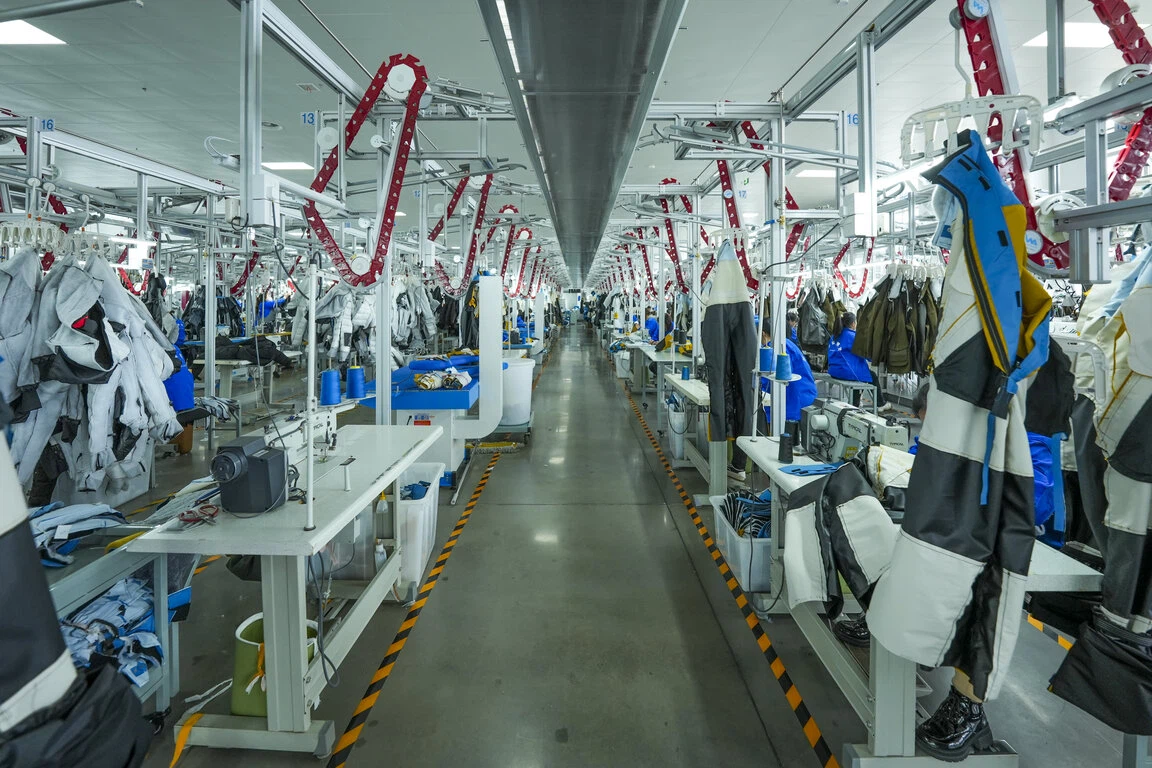
Being one of the biggest clothing manufacturers isn't just about size-it's about operational excellence. Here's what sets top-tier factories apart: protection,provide the most healthy home for you.
Key characteristics:
- Vertical integration: From yarn spinning to final sewing, everything is done in-house.
- Global client base: Supplying to major international brands like Nike, Zara, and Patagonia.
- Sustainability practices: Adoption of eco-friendly processes, recycled materials, and social compliance standards.
- Automation and innovation: Use of digital pattern making, 3D sampling, and smart warehousing systems.
- Mass customization: Ability to balance large volume with flexible styles, colorways, and branding.
This blend of scale + specialization allows the largest manufacturers to deliver consistently-even across millions of units annually.

The World's Largest OEM and ODM Clothing Manufacturers
Most of the top players operate under OEM (Original Equipment Manufacturer) and ODM (Original Design Manufacturer) models-offering either full production based on brand designs or providing ready-made styles for customization.
Examples:
Shenzhou International is a leading OEM for Nike and Uniqlo, producing exact-to-spec items.
Crystal Group offers ODM services, giving clients trend-driven designs that can be branded and adjusted.
Youngone is known for OEM/ODM outerwear production, working closely with performance brands.
These manufacturers support:
Tech pack development
Material sourcing and testing
Sampling, production, and packaging
Quality assurance and logistics
If you're a fashion brand aiming for scale, aligning with a trusted OEM/ODM apparel manufacturer is key to staying competitive.
Is the Largest Clothing Manufacturer Always the Best for Your Brand?
While it's impressive to work with a top global clothing manufacturer, it's not always the best fit-especially for small to mid-sized brands or highly specialized product lines.

Consider the trade-offs:
- High MOQs: Large manufacturers often require tens of thousands of units per style.
- Less flexibility: Custom requests, special materials, or experimental fits may not be prioritized.
- Slower communication cycles: Large corporations have complex internal approval layers.
- Startup-unfriendly: Many prefer working with well-established brands for predictability.
In short, big doesn't always mean better. For brands that value flexibility, customization, and category-specific expertise, a specialized manufacturer may be the smarter choice.
Why Hebei Loto Is a Scalable Yet Specialized Outerwear Manufacturer
At Hebei Loto, we focus on what we do best: custom outerwear manufacturing for global clients that demand both quality and agility.
Our core strengths:
Focused expertise:
Jackets, parkas, puffers, softshells-technical garments are our specialty.
01
Flexible order sizes:
We support growing brands with low MOQs and scale with them as demand increases.
02
OEM & ODM service:
Bring your design or use our templates-we provide support at every stage.
03
Strict QC & compliance:
ISO-certified, BSCI-compliant, and able to provide OEKO-TEX® fabrics on request.
04
Export-ready support:
End-to-end management including labeling, packing, documentation, and shipping.
05
Looking for a trusted manufacturing partner-not just the biggest one? Contact Hebei Loto for a custom quote or sample request.

FAQ: What You Need to Know About the Largest Clothing Manufacturers

01.Who is the largest clothing manufacturer in the world?
02.Should I work with a large-scale garment factory?
03.What's the main difference between OEM and ODM manufacturers?
04.Can small brands work with the world's largest clothing manufacturers?
05.What makes Hebei Loto different from other Chinese clothing manufacturers?